
Formulation science
The science behind a refined botanical experience.
Kinnale combines Thai botanical knowledge with structured formulation development, ingredient documentation, stability work, and responsible claims review.
Research should make a product clearer, not more confusing.
Kinnale's science communication is built around three principles:
- Explain what the formulation is designed to do
- Separate laboratory findings from consumer claims
- Publish only information that can be properly supported
Our objective is not to overwhelm customers with technical language. It is to show how ingredient selection, formulation design, testing, and safety review work together to create a credible product.
From botanical material to finished product.
Stage 1: Ingredient selection
Identify the botanical source, plant part, supplier, extraction method, and supporting documentation.
Stage 2: Ingredient characterisation
Review available technical data, composition, stability, impurities, and formulation compatibility.
Stage 3: Formula development
Combine the botanical ingredient with a suitable cosmetic base and evaluate spreadability, texture, appearance, and consistency.
Stage 4: Stability evaluation
Assess how the formula behaves over time under defined storage and temperature conditions.
Stage 5: Packaging compatibility
Evaluate whether the formula remains stable and suitable in the final packaging.
Stage 6: Safety assessment
Prepare the documentation required for evaluation by a qualified cosmetic Safety Assessor.
Stage 7: Claims review
Ensure that all public-facing benefit statements are proportionate, understandable, and supported.
Botanical input
Plai rhizome with documented supplier, origin and extraction method.
Emulsion architecture
Controlled oil-in-water system tuned for dispersion, stability and feel.
Test & assess
Stability, compatibility, microbiological and safety review before launch.
Delivery platform
Why formulation structure matters.
An emulsion is a system that brings together ingredients that do not naturally mix easily, such as oil-based and water-based components.
Kinnale's formulation work focuses on creating a stable, evenly dispersed system that supports consistent application, an elegant texture, and a reliable consumer experience.
Ingredient dispersion
The system is designed to distribute botanical components consistently throughout the formula.
Formulation stability
The product is evaluated to reduce unwanted separation, texture change, or visual instability.
Sensorial performance
The formulation is adjusted to balance massage glide, absorption, and after-feel.
Understanding nano-emulsion research.
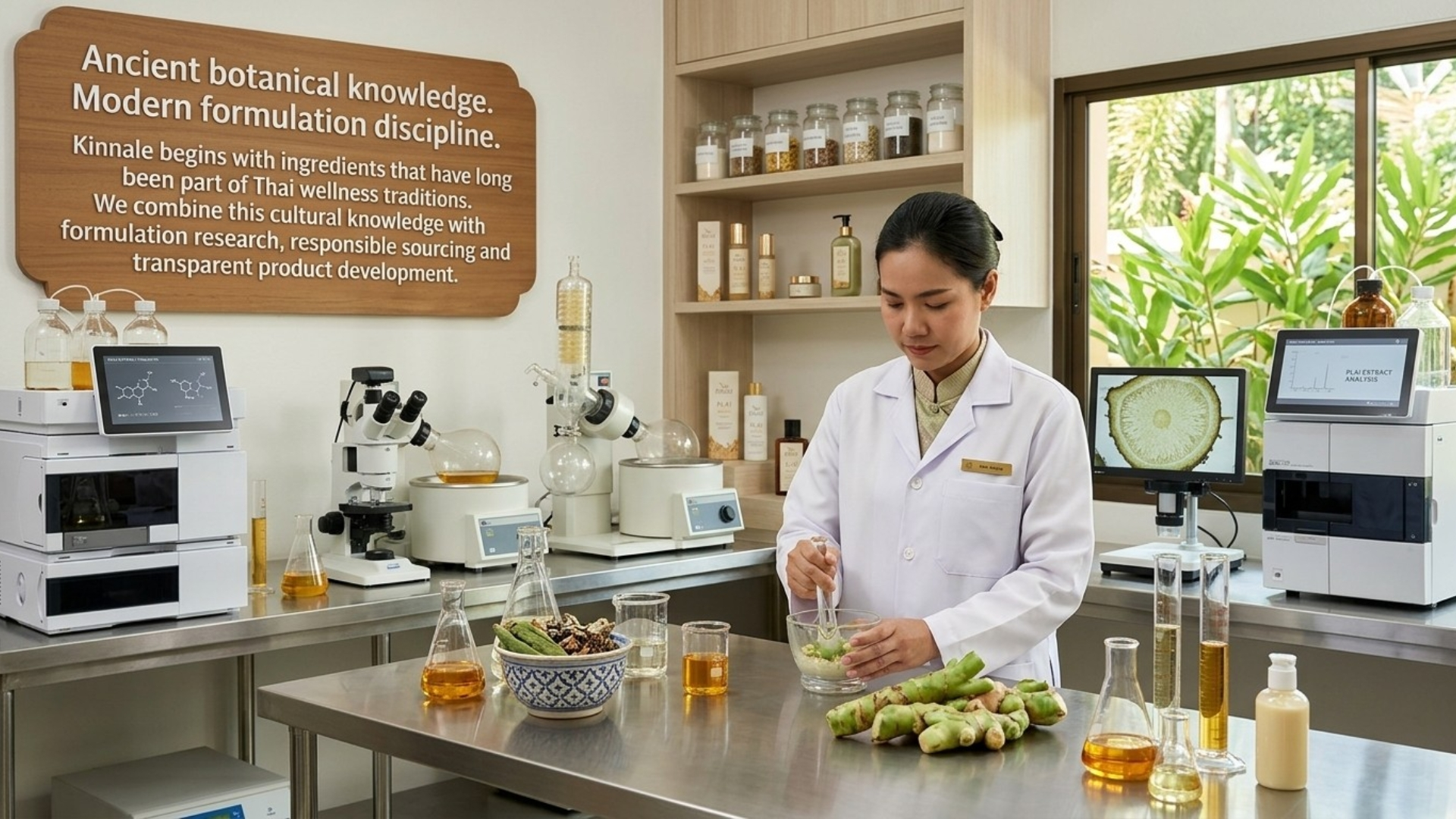
The research background connected to earlier Plaivazen Gold development includes work involving nano-emulsion and encapsulation approaches for Plai-derived compounds, alongside referenced research publications, patent applications, and international exhibition activity.
A smaller droplet system may influence how an ingredient is dispersed, protected, or incorporated into a formulation. It should not automatically be described as providing deeper penetration, faster action, or greater bioavailability unless those outcomes have been specifically tested for the final Kinnale product — a threshold Kinnale has not yet met and does not claim.
Built on a foundation of Thai research.
Kinnale's product concept draws from research and product-development activity connected to Thai botanical ingredients, particularly Plai and emulsion technology.
Plai emulsion development
Formulation research into emulsion and encapsulation of Plai-derived botanical components provides background knowledge for Kinnale's formulation design. It is treated as ingredient-level research, not as evidence for finished-product claims.
Thai patent application no. 1903002777
A patent application filed in Thailand relating to a double-layer emulsion concept from earlier Plai research. Referenced as an application only — not described as a granted patent.
Thai patent application no. 2101005678
An additional patent application filed in Thailand from earlier research work. Referenced as an application only — not described as a granted patent.
Geneva Exhibition 2023
Earlier Plai-related research from the founding team was presented at the International Exhibition of Inventions Geneva in 2023.
Evidence is built step by step.
Stability testing
Evaluates appearance, odour, texture, pH, and other defined parameters over time.
Packaging compatibility
Assesses whether the final package interacts negatively with the product.
Microbiological quality
Confirms that the product meets appropriate microbiological limits.
Preservative efficacy
Evaluates the ability of the preservation system to protect the formula when required.
Consumer perception
Measures how users perceive texture, absorption, fragrance, packaging, and overall product experience.
EU registration normally requires a technical documentation process including PIF, CPSR, a compliant label, CPNP notification, and an EU Responsible Person.
Evidence before exaggeration.
Kinnale distinguishes between:
Ingredient research
Evidence relating to a raw material or botanical component.
Formulation research
Evidence relating to a prototype or delivery platform.
Finished-product testing
Evidence relating to the exact product sold to consumers.
Only finished-product evidence should be used to support strong product-specific claims.
Science disclaimer. Research discussed on this page is provided for transparency and education. Research findings concerning ingredients, extracts, or earlier prototypes do not automatically demonstrate the same effect in the final cosmetic product.
Evidence map
External evidence vs internal research.
We split every reference into two columns so it is always clear what supports a consumer claim and what informs our development thinking.
External, published evidence
Peer-reviewed literature, monographs and regulatory references that exist independent of Kinnale.
- Botanical monographs on Zingiber cassumunar
- Published research on the phenylbutenoid chemistry of Plai
- EU Cosmetic Regulation (EC) No 1223/2009 framework
- ISO 22716 Good Manufacturing Practice for cosmetics
Internal Kinnale research
Development work owned by Kinnale or its partners. Informs design — does not, on its own, support consumer claims.
- Emulsion prototype iterations and texture evaluation
- Thai patent application no. 1903002777 — double-layer emulsion concept (application only)
- Thai patent application no. 2101005678 (application only)
- Geneva 2023 exhibition record
- Small-panel consumer perception sessions (planned before launch)
How Kinnale formulates: a visual flow.
Hover or tap each stage to read what it covers, and see which evidence type supports it.
Plai extract
Botanical input is sourced from Zingiber cassumunar (Plai) with documented supplier, plant part, country of origin and extraction method.
- External, published: Botanical monographs on Zingiber cassumunar
- External, published: Published research on phenylbutenoid chemistry of Plai
- Internal Kinnale research: Supplier Certificate of Analysis
Evidence questions, explained.
"Clinically proven" — when can a brand actually say it?
Only when a relevant clinical study has been conducted on the exact finished product (or a directly equivalent formula), using a recognised methodology, with documented sample size, protocol, and results. A study on an ingredient alone is not enough.
Does a patent prove the product works?
No. A patent — and especially a patent application — protects a technical idea. It does not certify performance, safety or efficacy on consumers. Kinnale references its applications transparently and never describes them as granted patents unless ownership and grant status are confirmed.
What does "nano-emulsion" mean for the consumer experience?
It refers to a smaller droplet structure in the formulation. It can affect dispersion and feel. It does not automatically translate into deeper penetration, faster onset or stronger biological effect — those would each require their own finished-product evidence and regulatory review.
Why isn't Herbal Gold sold as a pain-relief product?
Pain relief is a medicinal claim. Kinnale Herbal Gold is intended as a cosmetic body cream supporting a relaxing massage experience — not as a substitute for medical treatment.
What's the difference between "research" and "product proof"?
Research informs how we design the product. Product proof comes from testing the final, sealed, market-ready formula. We are careful to label every claim with the evidence type that supports it.
Where will Kinnale publish testing results?
Approved stability, microbiological, and consumer-perception summaries will be added to this page as each report completes qualified review.